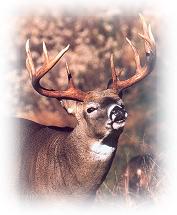
Several months before whitetail deer begin to mate, the bucks begin to establish dominant behaviors. A social hierarchy which consists of three phases is formed during the whitetail breeding season. The three phases are prerut, rut, and postrut.
During the summer, usually about 5 or 6 bucks live together in open grasslands or prairies along with some does and fawns. Dominance among bucks is determined by the size of the bucks and their racks. Deer with small racks avoid those with larger racks, and will often groom the larger bucks by licking them on their shoulders and necks.
Smaller bucks will avoid eye contact and will even move out of the way of larger bucks. In the summer, bucks will rarely settle disputes with their antlers because the antlers are very sensitive and can be injured very easily. The antlers are "in velvet" and will stay in open areas to avoid damaging their antlers. By the end of the summer, almost every buck knows his own position in the hierarchy.
In the fall, summer groups break apart and the bucks become increasingly antagonistic as their antlers begin to harden, usually between September and October. This is known as the prerut stage. The dominant bucks will stay near the home front in order to maintain the social order.
During this period, bucks will begin to make rubs, which is the bucks way of marking his territory and making his presence known to the other deer These bucks will scrape small trees with their antlers, knocking the bark off around two feet from the ground. Early rubs are about 6 inches long and a third of the way around the tree. Later rubs can be twice as big. A buck will deposit scents from their preorbital glands as they rub these trees. Bucks often tend to rub aromatic trees such as cedar, pine, and cherry and will rarely revisit a rub.
As soon as bucks start making rubs, they will challenge each other by sparring. One buck will approach another buck, holding his head low. Then they will begin pressing their antlers or foreheads together, and begin pushing each other. Sparring typically takes place in the daytime. This sparring helps to reinforce the social ranks that were established earlier in the summer. Sparring is most common among similar sized bucks. Later in the prerut, bucks will become increasingly aggresive and will challenge each other more often,
Sparring ends with the beginning of the rut phase, which begins when the does go into estrus, which typically lasts between 24 and 36 hours. During this time period, does are receptive to breeding. Does go into estrus at different times, so the rut can continue for a month or more. Rutting activity usally begins in mid October and can last well into January, depending on the location.
Before the rut begins, bucks will start creating bare patches or depressions in the ground, which are known as scrapes. As the rut becomes underway, more and more scrapes will be made. Scrapes are usually 1 to 4 feet long. Scrapes are usually made where there isn't much ground cover. A buck will make several lines or clusters of scrapes near his home turf, which will increase the odds of does finding them. Bucks will also deposit scents and urine on these scrapes.
The urine is the strongest and most important scent used to mark the bucks territory. Bucks will urinate on their legs, mixing the urine with scents from the tarsal glands. This strong smelling mixture is then deposited into the scrapes, and can last several days. Does will signal the bucks when ready to breed by urinating into these scrapes. Does sometimes make their own scrapes. The rut is the best time to hunt, when bucks are preoccupied with breeding activities. Bucks will become careless and vulnerable during breeding.
Courting activity is initiated when a buck catches a whiff of a doe in estrus. He will begin to give chase to the doe once he has her tracked. The buck holds his head low with chin upward as he begins the chase. He then makes deep and long grunts, and will also make snorts and wheezes during the chase. When a buck approaches a doe, she will flee until she is ready to begin breeding. During mating, bucks are very intolerant of each other and will lock their anters together in battle, even to the point of killing each other. Once a doe goes into estrus, the buck will feed and bed with her. This behavior is called tending. At this point, he will sniff her rump and chase her. They will copulate several times while she is in estrus.
The final phase of the breeding season, postrut, begins once all the breedable does have been bred. At this point, the male hormone levels will drop, and rubbing and scraping activities diminish. Most bucks will lose their antlers in a month after rut ends. Some healthier bucks may carry the antlers for several more months. When breeding is completed, bucks will begin feeding heavily to put on extra fat for the upcoming cold weather.
When the 6 1/2 month gestation period ends, does leave the family groups and go off to deliver in May or June. Does will usually give birth to twins or triplets. Does will remain isolated from the rest of the group until the fawns are fully nursed. After approximately one month, the doe and fawns will join the family group. |